AUSTRAC has released its regulatory priorities ahead of major reforms to Australia’s Anti‑Money Laundering and Counter‑Terrorism Financing (AML/CTF) framework, with new obligations for ‘Tranche 2’ entities, including real estate agents, lawyers, accountants, conveyancers, jewellers and trust/company service providers, scheduled to commence from 1 July 2026.
For existing reporting entities, however, the first milestone arrives much sooner: 31 March 2026, when the expanded AML/CTF obligations begin under the reformed regime for current AFSL and ACL licensees. According to AUSTRAC’s official reform roadmap, financial services licensees must use the lead‑up period to update their risk assessments, strengthen customer due diligence, and prepare for enhanced reporting and record‑keeping requirements. Recent enforcement actions, including substantial penalties issued to crypto ATM operators, highlight the regulator’s expectation that industry uplift occur well before the deadlines.
Many businesses underestimate the complexity of AML/CTF compliance, especially as new sectors come under regulation. For Tranche 2 entities, this is the first time they will operate under AUSTRAC oversight, bringing obligations around suspicious matter reporting, customer due diligence, record‑keeping, and programme governance.
But AFSL and ACL holders are equally impacted: AUSTRAC has made it clear that existing reporting entities must transition into the reformed regime, not simply continue “business as usual.” This includes grappling with new definitions of designated services, additional reporting thresholds, and program changes that require updated technology, revised procedures, and stronger frontline capability. With greater regulatory focus on private credit, mortgage broking, financial advisers, and credit licensees, compliance leaders will face increased scrutiny around how they assess, mitigate, and document ML/TF risks.
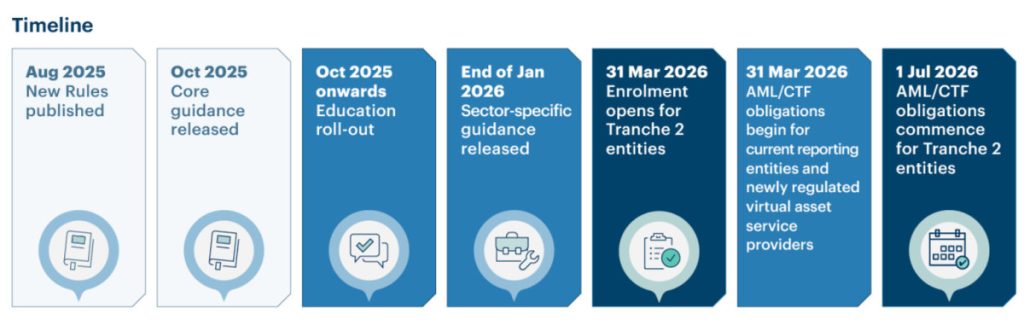
To prepare for the March reforms, AUSTRAC recommends that AFSL and ACL compliance managers begin by reviewing their current AML/CTF programmes against the new obligations coming into force. This includes conducting a new enterprise‑wide ML/TF risk assessment, ensuring that customer due diligence processes are updated to reflect new definitions and risk triggers, and confirming that systems can support enhanced reporting requirements, particularly for suspicious matter reporting, international funds transfer instructions, and threshold transactions. AUSTRAC also expects licensees to maintain up‑to‑date enrolment details and establish clear implementation plans to demonstrate ongoing progress. For credit licensees, mortgage brokers, and financial advisers, this means mapping the client journey end‑to‑end to identify gaps in identity verification, beneficial ownership collection, and enhanced due diligence processes.
Tranche 2 reforms will also create downstream impacts that AFSL and ACL holders must prepare for. As lawyers, accountants, conveyancers and other gatekeeper professions enter the AML/CTF regime, AFSL and ACL holders will need to adjust their outsourcing, referral and third‑party arrangements to ensure that partners are also appropriately regulated. For example, credit licensees relying on accountants for source document verification or advisers working with accountants and solicitors on client restructures will need new due diligence steps. The reforms also bring additional expectations around data quality, record‑keeping, and reporting accuracy that will require technology uplift for many licensees. Early preparation will make this transition significantly easier, reducing the risk of errors, delays, or remediation once the laws take effect.
By acting now, AFSL and ACL holders can ensure a smooth transition into the reformed regime. Early preparation means stronger audit outcomes, reduced enforcement risk, and greater confidence in your AML/CTF framework. Organisations that demonstrate a proactive approach build trust not only with AUSTRAC but also with clients, partners, and the broader community. In the rapidly changing AML/CTF environment, preparedness is not only a regulatory best practice but also a competitive advantage.
Failure to implement the required changes by 31 March 2026 risks significant penalties, remediation costs, and reputational damage. AUSTRAC has emphasised that it will act against entities that fail to meet their obligations, especially where non‑compliance exposes the financial system to criminal exploitation. The new Tranche 2 regime will not dilute expectations for current reporting entities; if anything, it raises the bar.
Call to Action:
Don’t wait until the March deadline approaches. Book an AML/CTF readiness review with AICS to identify gaps, strengthen your programme, and prepare your team for the new AML/CTF landscape. Our experts can help you navigate the reforms, update your policies, and ensure your business is compliant and confident ahead of the 2026 rollout.
References: